A spacecraft that has been in orbit around Mars for over a decade has suddenly stopped communicating. Known as MAVEN (Mars Atmosphere and Volatile EvolutioN), the spacecraft - which launched in 2013 - has spent more than 11 years analyzing the planet's atmosphere and ionosphere.
Things had been operating normally when, on December 6th of this year, its signal was lost as it orbited behind the Red Planet - an expected and routine event of typically little concern. When it was due to re-emerge and re-establish contact, however, there was nothing but silence.
NASA's Deep Space Network listened out intently as operations teams attempted to contact the spacecraft, but so far nothing has been picked up at all. Exactly why the probe would go totally silent when everything had been working correctly just a short time ago currently remains a complete mystery.
What could have happened to it? "Telemetry from MAVEN had showed all subsystems working normally before it orbited behind the Red Planet," NASA wrote. "After the spacecraft emerged from behind Mars, NASA's Deep Space Network did not observe a signal. The spacecraft and operations teams are investigating the anomaly to address the situation. More information will be shared once it becomes available."
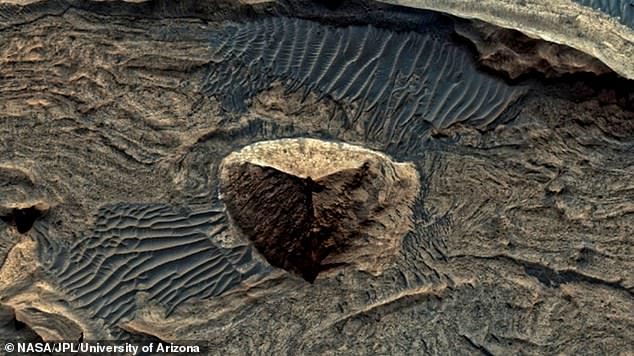
A mysterious pyramid-like structure spotted on Mars has sparked theories that an ancient civilization similar to our own may have once existed on the Red Planet. A viral post has flooded the internet this week, highlighting a NASA video of the Martian surface that some claim shows a three-sided pyramid.
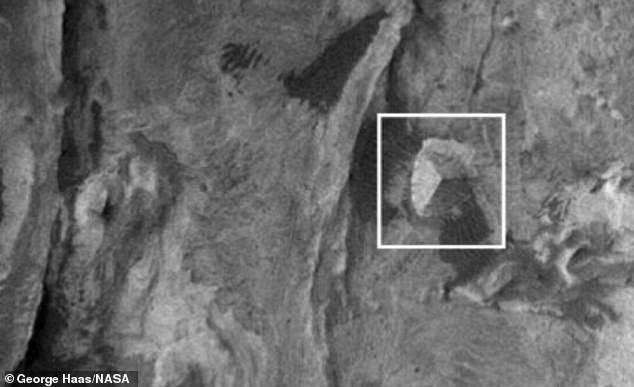
The formation was initially spotted by researcher Keith Laney in footage captured by NASA’s Mars Global Surveyor (MGS) in 2001. He was scanning the imagery for unusual structures when he came across what he believes could be an artificial formation. He is quoted as saying: 'Were this found anywhere on Earth, we'd surely be digging into it.'
The footage was recently reshared by documentary filmmaker Brian Dobbs, who claimed: 'On Mars, there is a three-sided pyramid the size of the Great Pyramid in Egypt.' Dobbs acknowledged the structure is far from proof of ancient life, but said it raises questions about whether another species could have once inhabited the planet. The so-called 'pyramid' sits in the western region of Candor Chasma, one of the largest canyons within Valles Marineris, the second-largest canyon system in the solar system. The region is known for steep cliffs, landslides and layered rock formations, which scientists say can naturally create unusual and highly geometric surface features.
The formation has been observed across five separate images taken by NASA’s Mars Global Surveyor and Mars Reconnaissance Orbiter missions between 2001 and 2016. The earliest image, taken on July 4, 2001, showed the formation illuminated from the west, highlighting one face of the structure while the others fell into shadow. A follow-up image in April 2002 captured similar features under different lighting conditions, again revealing a three-sided shape.
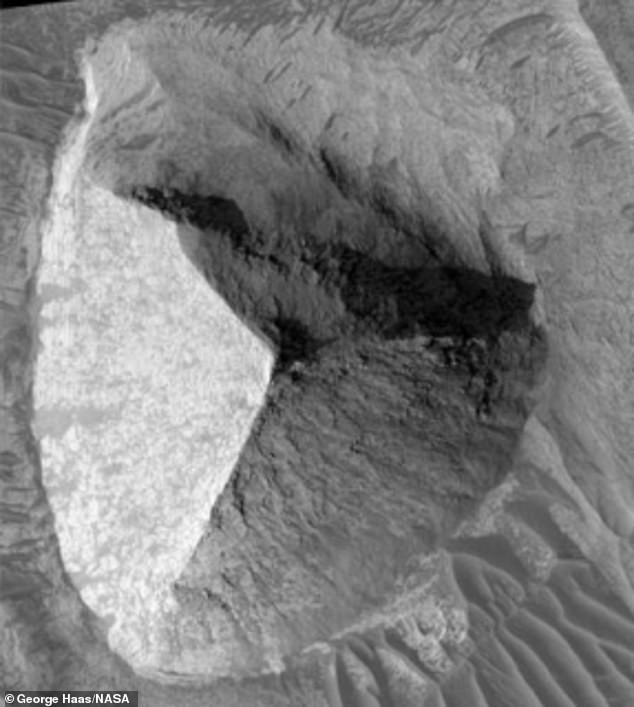
Later, more detailed images from the Mars Reconnaissance Orbiter, including one taken in 2007 with a much higher resolution, revealed additional surface features that were not visible in earlier photographs. These images showed sharper edges and more defined symmetry across the structure’s faces. Further images taken in 2014 and 2016 continued to show the same triangular formation, with shifting sunlight casting varying shadows that emphasized its geometric appearance. In some cases, one side of the structure appeared almost completely dark, while others were partially illuminated.
Researchers noted that despite differences in image quality, sun angle and seasonal conditions, the formation consistently displayed a uniform, three-sided symmetry across all observations. Dobbs is just one of many believers who have questioned whether potentially alien or artificial buildings on Mars, such as pyramids, could exist. Speaking to the Daily Mail last year, Mars researcher George Haas echoed Laney's findings and other investigations into similar objects on the planet's surface. 'You don't have to be a geologist to know the difference between a rock and a sculpture, something that's geometric,' he explained.
In a research paper co-authored with other investigators, Haas reported that 'the structural form of this three-sided pyramid observed within the western region of Candor Chasma is real and exhibits a level of geometry and symmetry that supports a high probability of artificial origins.' Laney commented on Haas's findings, saying that the pyramid is 'most definitely artificial.' At the end of 2025, unearthed CIA documents revealed that the agency had conducted mysterious experiments in an effort to learn more about Mars.
According to the agency, these missions revealed that an ancient civilization that built at least one pyramid did exist, lending credence to Laney's research. Codenamed 'Project Stargate,' the researchers allegedly transported a subject's consciousness back in time via astral projection. The subject described seeing a mysterious pyramid and a road that suggested an ancient civilization lived on the planet.
'It sort of looks... I kind of got an oblique view of a ah... pyramid or pyramid form,' one of the test subjects of Project Stargate said. Additionally, former CIA agent Joe McMoneagle also revealed that the agency had conducted experiments that spotted similar-looking pyramids across the surface of Mars. McMoneagle described a pyramid larger than the ones in Egypt, filled with 'monster rooms.'
Without actually setting foot on Mars, it will be difficult to determine the exact makeup of pyramids such as these, but that hasn't stopped rampant speculation of how they were created.
Although we don't hear about it as much these days, the hunt for evidence of life on Mars continues unabated, with both of NASA's exploratory rovers scouring the Martian surface for clues pointing to the existence of primitive organisms that might have lived there in the planet's distant past. Now, the Curiosity rover has discovered what appear to be organic molecules on Mars, some of which having never been found on the Red Planet before.
Despite the fact that it is not possible to determine if these molecules are actually traces of ancient Martian life, the find is particularly exciting because it shows that some of the building blocks of life were on Mars 3.5 billion years ago and that traces of them have been preserved all that time. This means that if there really was life on the Red Planet in its distant past, traces of that could be preserved as well.
"We think we're looking at organic matter that's been preserved on Mars for 3.5 billion years," said mission scientist and University of Florida astrogeologist Prof Amy Williams. "Is it life? We can't tell, based on this information."
"For a long time, we thought that all organic matter was going to be seriously degraded by that harsh radiation environment. It's really exciting to see [that] large complex material can survive in the subsurface environment."
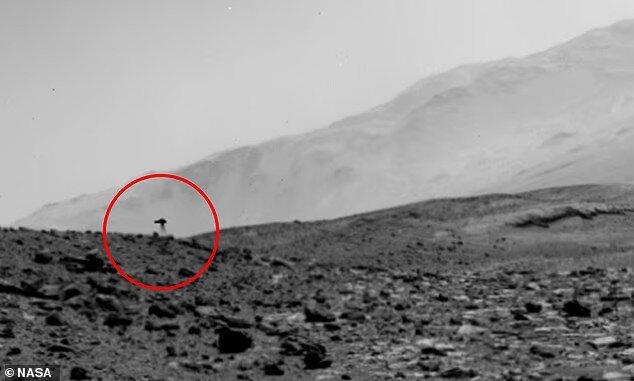
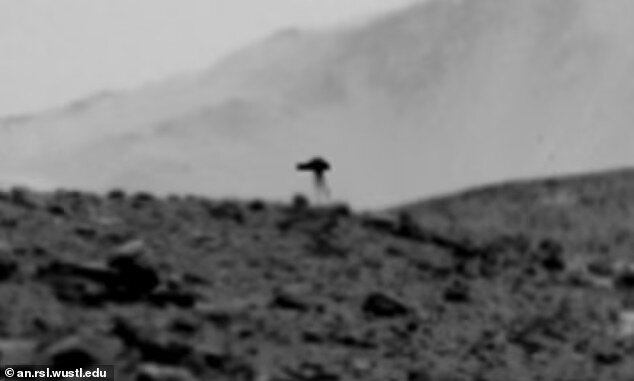
An unearthed NASA image of Mars has captured a strange object in the distance, which some have suggested was a jellyfish-like being or mechanical device.
NASA's Curiosity rover, which has been investigating whether Mars could have supported microbial life for the last 14 years, snapped the image on August 20, 2023 at around 6.27pm ET.
It shows the dusty Martian landscape with rocky hills and large mountains.
However, the panorama also revealed a small figure in the left corner that appeared to have a large black body perched atop two spindly legs.
Fueling speculation that NASA’s rover had captured something moving across Mars, images taken of the same area less than a minute earlier showed no sign of the mysterious figure.
Moreover, the photo with the object was the last image posted on NASA's website for that day. The next picture from Curiosity was taken nearly two hours later with the camera pointed in a different direction.