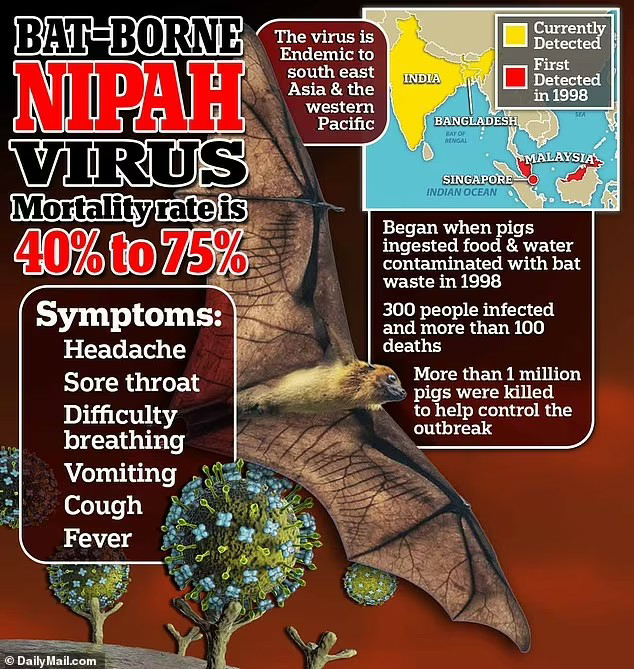
Nipah Virus Outbreak

nivek

As Above So Below

UK health chiefs 'closely monitoring' outbreak of deadly virus in India

An Indian outbreak of Nipah virus, which has no cure and can kill 75 per cent of those it infects, is being 'closely monitored' by UK health leaders.

The spike in cases of the virus, which inspired the Hollywood pandemic thriller 'Contagion', has already killed two people in the southern state of Kerala.

Five other cases have been detected, including a child of one of the victims, with over 800 people being testing.

The UK Health Security Agency (UKHSA) told MailOnline it was 'closely' monitoring the outbreak.

Authorities have closed down schools and offices and declared nine villages as containment zones over fears of the brain-damaging virus.
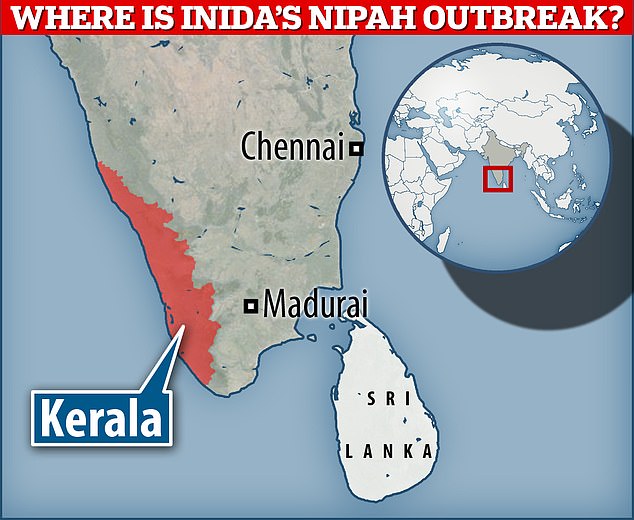
India is currently experiencing an outbreak of Nipah virus in the southern state of Kerala, the fourth since 2018


Public transport has also been suspended and neighbouring states are testing travellers from Kerala for potential symptoms.

Nipah is spread by fruit bats who can transmit the virus to people via contact with infected bodily fluids like saliva or urine left on fruit.

These people can then go on to infect others by close contact including potential airborne transmission through coughing and sneezing.

Nipah can kill by causing both severe respiratory problems and fatal brain swelling.

No vaccine or medication work against the virus, with treatment focussed on helping patients survive the symptoms while the body fights off the infection.

A UKHSA spokesperson said: 'UKHSA’s emerging infections and zoonoses team continue to monitor the Nipah outbreak closely though our epidemic intelligence processes.'

'Nipah virus has not been detected in the UK and the risk of importation into the UK is very low.'

Professor Miles Carroll, an expert in emerging viruses at the Pandemic Sciences Institute at the University of Oxford, said they were 'closely monitoring' the outbreak.


(More on the link)

.
 

nivek

As Above So Below
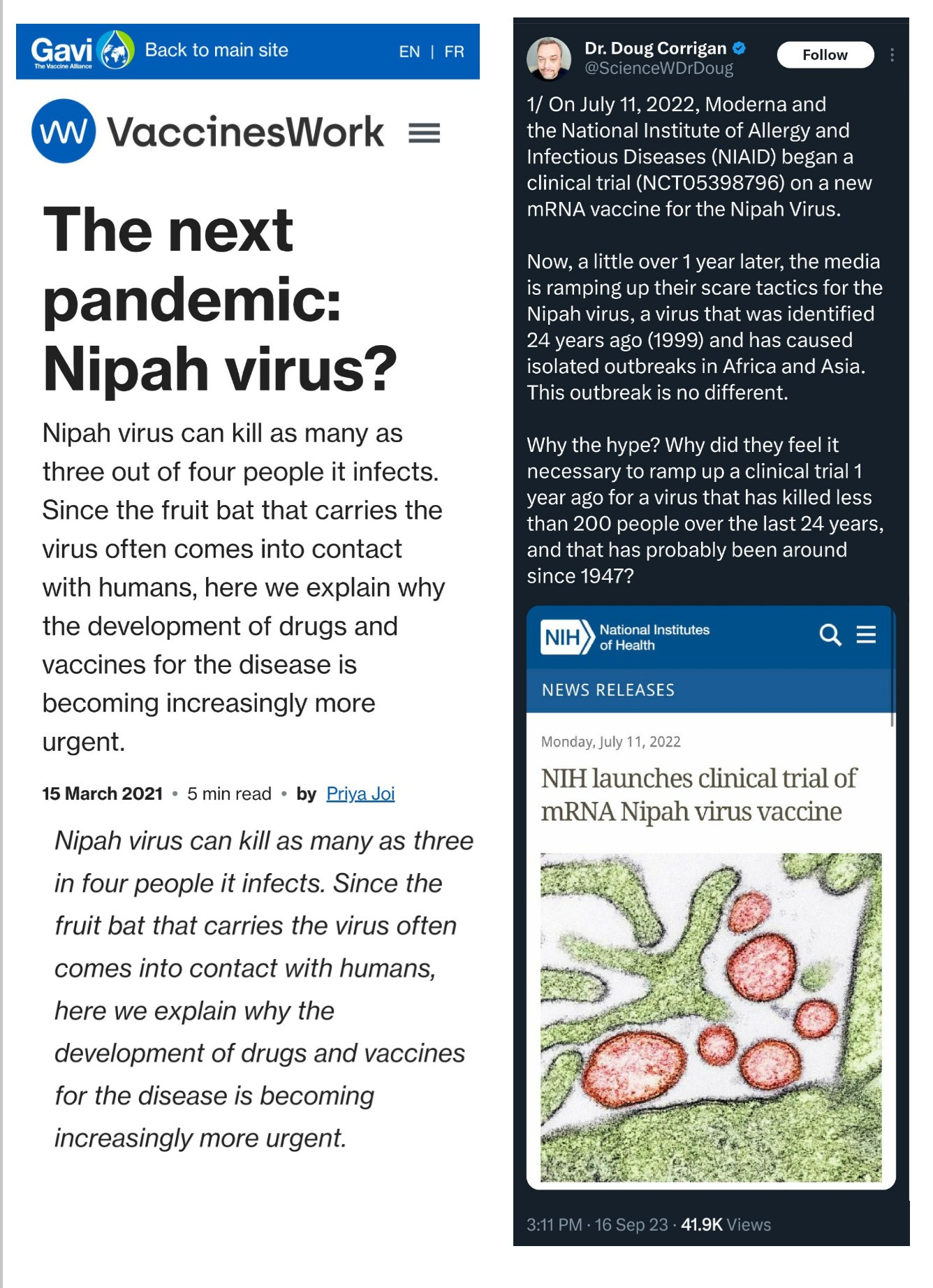
Bill Gates GAVI "predicted" a Nipah virus pandemic in 2021. In 2022, Gates-funded Moderna and NIAID began a clinical trial on a new mRNA vaccine for Nipah Virus. Now we have reports of a Nipah outbreak. 75% death rate.

Coincidence?


nivek

As Above So Below

Next pandemic deemed the 'Big One' could be the most contagious and deadliest disease known to humanity, scientists warn

The next pandemic, dubbed the 'Big One,' could be 'simmering in the background,' waiting to unleash the most contagious and deadliest diseases known to humanity.

The paramyxovirus family has over 75 viruses, including mumps, measles and respiratory tract infections, and was added to the list of the National Institute of Allergy and Infectious Diseases' pandemic pathogens to watch in October.

One of the viruses, the Nipah virus, can infect cells with receptors that regulate what gets in or out of cells that line the central nervous system and vital organs.

This variant has a fatality rate of up to 75 percent compared to Covid's, which is well under one percent.

Scientists note that unlike the flu and Covid-19 are 'speedy shape-shifters,' paramyxoviruses appear not to mutate as they spread, but they have become 'very good at transmission among humans.'


(More on the link)

1699109115762.png

.
 

nivek

As Above So Below

Officials reinstate Covid-era monitoring and quarantines after outbreak of deadly virus that has no cure

Health officials and airports have reinstated Covid-era restrictions amid an outbreak of a deadly virus that has no cure. Several airports across Asia have stepped up precautionary measures after India's West Bengal region confirmed five cases of Nipah virus, which is carried by bats and infects both pigs and humans.

The disease, which has never been seen in North America, can also spread from person to person. It has a fatality rate between 40 and 75 percent, according to the World Health Organization, from complications such as respiratory failure and brain swelling. About 100 people in West Bengal are now being quarantined after the virus was detected in a hospital, officials said. A doctor, a nurse and another staff member at the hospital tested positive after the first two cases were detected in a male and female nurse from the same district.

Narayan Swaroop Nigam, the principal secretary of the Department of Health and Family, said one of the two nurses is in critical condition after both developed high fevers and respiratory issues between New Year's Eve and January 2. The critically ill nurse, who is now in a coma, is believed to have contracted the infection while treating a patient suffering from severe respiratory problems. That patient died before tests for Nipah virus could be carried out.

In response to the outbreak, Thailand's ministry of public health implemented health screening for passengers at major airports arriving from West Bengal. Passengers are being evaluated for fever and other Nipah virus symptoms, which include headache, sore throat, vomiting and muscle pain. Travelers are also being issued health 'beware' cards educating them on what to do if they become ill. Phuket International Airport in Thailand is also undergoing increased cleaning. No cases have been reported in Thailand, but Phuket International Airport operates several direct flights to West Bengal.

There is no sign of Nipah virus spreading to the US or elsewhere in North America, and the CDC has not issued any travel advisories related to the virus. Local media reports state that travelers with a high fever or other symptoms consistent with Nipah virus will be taken to quarantine facilities. The department for public parks and wildlife has also ordered stricter screenings for caves and tourist attractions in Thailand.

Nepal has raised alert levels with Tribhuvan International Airport in Kathmandu and land crossings bordering India to prevent Nipah virus from entering the country. Additionally, health authorities in Taiwan have said they are planning to list Nipah virus as a Category 5 notifiable disease, the highest classification for serious emerging infections under local law. This would require immediate reporting and special control measures if cases occur.

Taiwan’s Centres for Disease Control said Taiwan is maintaining its Level 2 'yellow' travel alert – that alerts travelers to exercise caution – for Kerala state in southwestern India. The CDC’s deputy director-general Lin Ming-cheng said travel advisories will be updated as the outbreak evolves. Nipah virus is zoonotic, meaning it can be transferred from animals to humans. It was first recognized in 1999 during an outbreak among pig farmers in Malaysia and has since been detected in Singapore, Bangladesh, India and the Philippines.

The WHO states that Nipah transmission is thought to occur when people are exposed to secretions from animals or contact with the tissue of a sick animal. Some outbreaks have been traced back to fruits or fruit products, such as juice, that were contaminated with urine or saliva from infected fruit bats.

The illness can also be spread from human to human. About 750 cases have been detected globally, along with over 400 deaths. Many patients have no symptoms, but those who do report signs four to 14 days after initial infection. Initial symptoms include fever, headache, sore throat, vomiting and muscle pain, though these can rapidly progress to dizziness, confusion, seizures, respiratory distress, coma and encephalitis, deadly inflammation in the brain.

There is no vaccine or cure, and doctors can only treat the symptoms.


.
 

nivek

As Above So Below

Travel experts issue new Nipah virus warning as countries ramp up screening measures ahead of Chinese New Year passenger surge

Experts have warned that millions of people travelling to and from Asia for Chinese New Year could potentially trigger a spike in Nipah virus cases. India has so far confirmed two cases of Nipah virus, a rare disease that can be caught from contact with an infected person or by consuming food or drink contaminated with the faeces, urine or saliva of infected fruit bats.

Lunar New Year sparks the world’s largest annual travel migration with millions of people travelling to and from Asia. The 40-day Lunar New Year travel season, known as chunyun, begins on February 2 this year and runs until March 13, involving billions of passenger journeys across the China.

The China State Railway Group is anticipating a record 539 million rail passenger journeys between this period, a five per cent year-on-year increase. Several countries have implemented screening measures in people arriving at airports, while others are tightening the ones they already have in place after the potentially deadly bat-borne virus was detected in humans. On Thursday, Pakistan became the latest country to order enhanced screening of people entering the country to look for signs of Nipah virus.

Thailand, Singapore, Hong Kong, Malaysia, Indonesia and Vietnam have all also implemented enhanced screening procedures at airports, and the UK has warned travellers about taking precautions when travelling to West Bengal, the region of the outbreak. The 40-day Lunar New Year travel season, known as chunyun, begins on February 2 this year and runs until March 13. Pictured: Huge crowds travelling in Shanghai, China, during the Spring Festival travel rush last year

Though public health experts note the risk of widespread transmission remains low, Chinese social media is reporting growing concern about the deadly infection in the country.


.
 
Top