Robots

pigfarmer

tall, thin, irritable
Throwflame unveils robot dog Thermonator — with flamethrower attached

Throwflame unveils robot dog Thermonator — with flamethrower attached​


A company have unveiled a robot dog companion — with flamethrower attached.
Throwflame say the Thermonator is the first-ever flame-throwing quadruped robot dog.
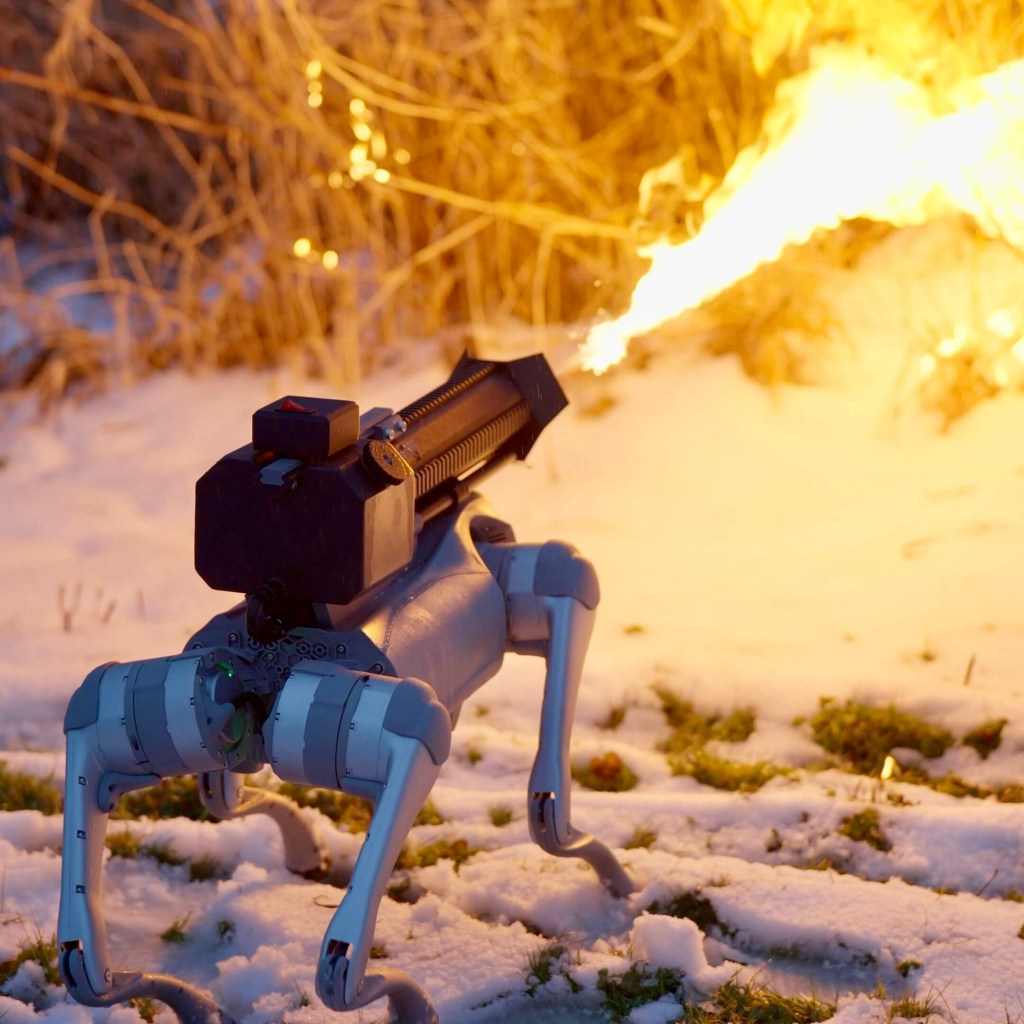
Throwflame say the Thermonator is the first-ever flame-throwing quadruped robot dog. 4
Throwflame say the Thermonator is the first-ever flame-throwing quadruped robot dog.Throwflame / SWNS
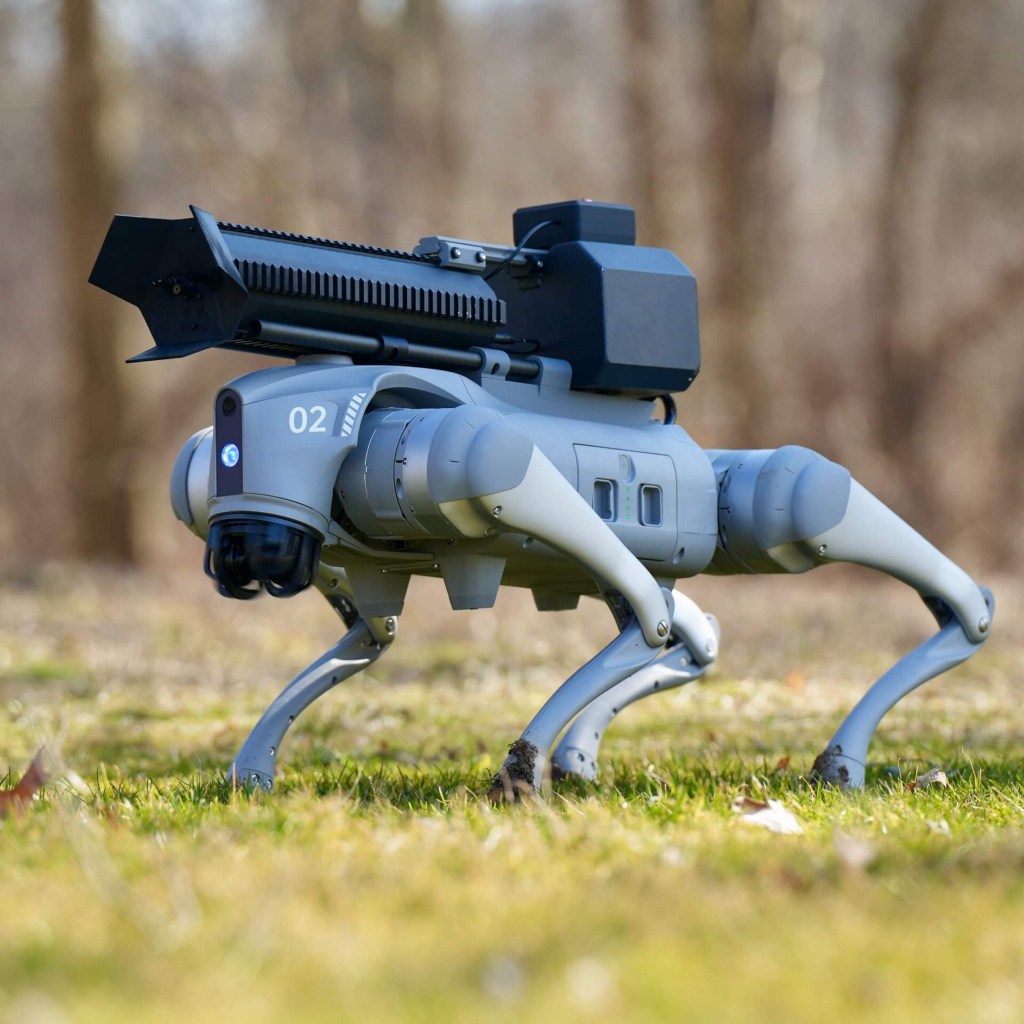
The firm have announced the $9,420 bot is available for purchase by the general public and government agencies for the first time.  4
The firm have announced the $9,420 bot is available for purchase by the general public and government agencies for the first time. Throwflame / SWNS

The Ohio-based firm have announced the $9,420 bot is available for purchase by the general public and government agencies for the first time. The Thermonator can be remotely operated by wifi or bluetooth to fire jets of fire up to 30ft. Able to avoid obstacles and leap through the air, the device has laser sighting and can operate for an hour.Throwflame suggest the robot can be used for wildfire control and prevention, entertainment shows or even clearing snow and ice from your driveway.
company-unveil-1173909.jpg

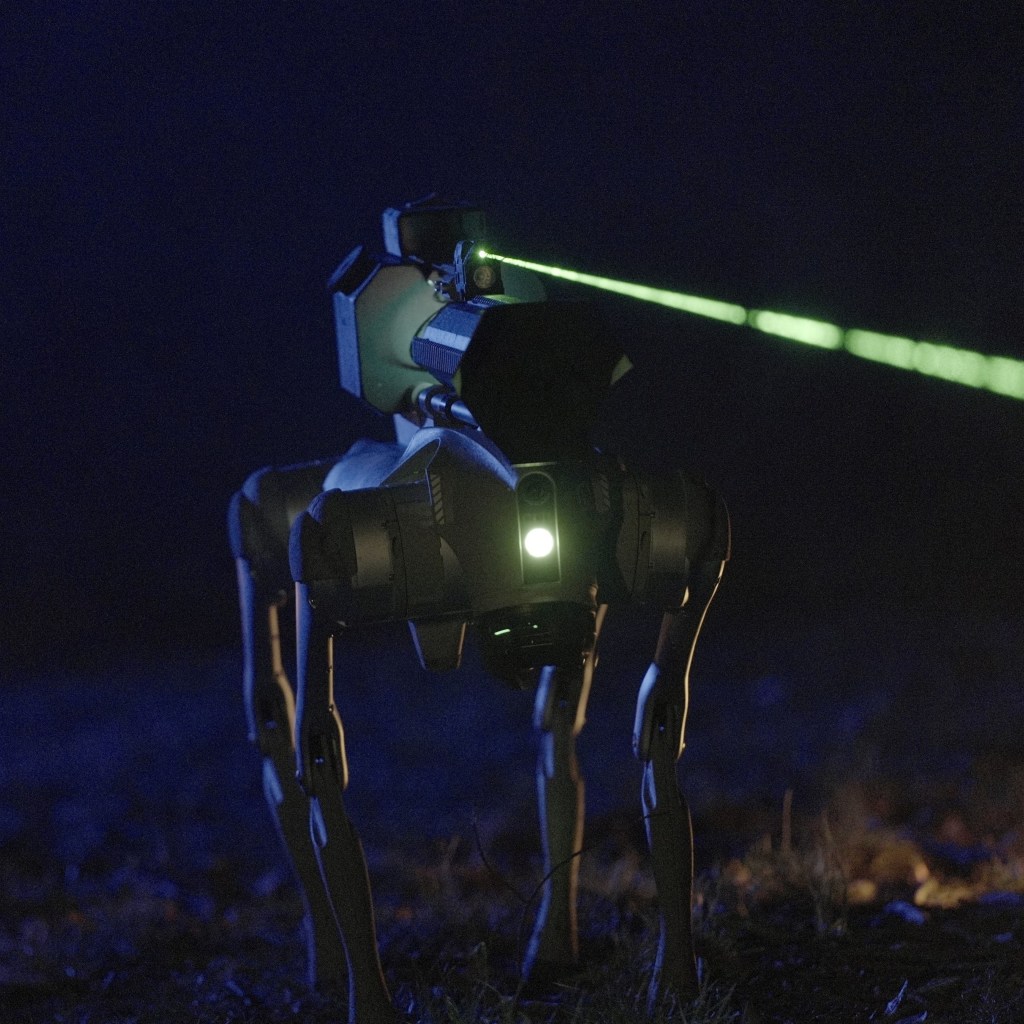
The device has laser sighting and can operate for an hour.Throwflame / SWNS
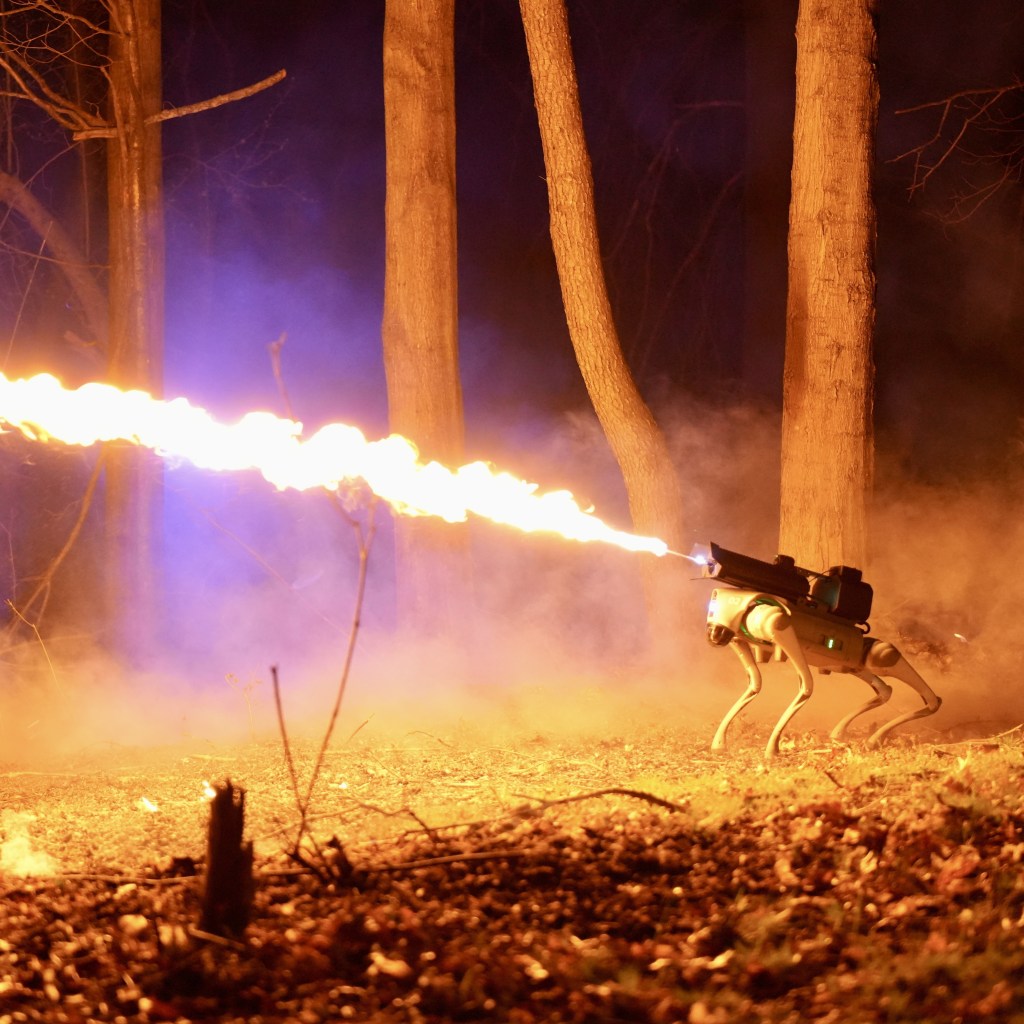
The Thermonator flamethrowing robot dog. 4
Throwflame says “This quadruped is coupled with the ARC Flamethrower to deliver on-demand fire anywhere!”Throwflame / SWNS
A chilling video shows a Thermonator creeping through a forest before torching its surroundings.


Throwflame say: “This quadruped is coupled with the ARC Flamethrower to deliver on-demand fire anywhere!”
 

AD1184

Celestial
Throwflame unveils robot dog Thermonator — with flamethrower attached

Throwflame unveils robot dog Thermonator — with flamethrower attached​


A company have unveiled a robot dog companion — with flamethrower attached.
Throwflame say the Thermonator is the first-ever flame-throwing quadruped robot dog.
Throwflame say the Thermonator is the first-ever flame-throwing quadruped robot dog. 4
Throwflame say the Thermonator is the first-ever flame-throwing quadruped robot dog.Throwflame / SWNS
The firm have announced the $9,420 bot is available for purchase by the general public and government agencies for the first time.  4
The firm have announced the $9,420 bot is available for purchase by the general public and government agencies for the first time. Throwflame / SWNS

The Ohio-based firm have announced the $9,420 bot is available for purchase by the general public and government agencies for the first time. The Thermonator can be remotely operated by wifi or bluetooth to fire jets of fire up to 30ft. Able to avoid obstacles and leap through the air, the device has laser sighting and can operate for an hour.Throwflame suggest the robot can be used for wildfire control and prevention, entertainment shows or even clearing snow and ice from your driveway.
company-unveil-1173909.jpg

The device has laser sighting and can operate for an hour.Throwflame / SWNS
The Thermonator flamethrowing robot dog. 4
Throwflame says “This quadruped is coupled with the ARC Flamethrower to deliver on-demand fire anywhere!”Throwflame / SWNS
A chilling video shows a Thermonator creeping through a forest before torching its surroundings.


Throwflame say: “This quadruped is coupled with the ARC Flamethrower to deliver on-demand fire anywhere!”
I wonder if in the near future, rather than a mass-shooting, there will be an event where someone decides to immolate crowds of people with a hacked, AI-controlled Throwflame Thermonator, or similar robot.
 

pigfarmer

tall, thin, irritable
Jesus, that's a chilling thought. Bluetooth Terminators. You're right though, something like that is probably coming.
 

Creepy Green Light

Silence = Deaf
Throwflame unveils robot dog Thermonator — with flamethrower attached

Throwflame unveils robot dog Thermonator — with flamethrower attached​


A company have unveiled a robot dog companion — with flamethrower attached.
Throwflame say the Thermonator is the first-ever flame-throwing quadruped robot dog.
Throwflame say the Thermonator is the first-ever flame-throwing quadruped robot dog. 4
Throwflame say the Thermonator is the first-ever flame-throwing quadruped robot dog.Throwflame / SWNS
The firm have announced the $9,420 bot is available for purchase by the general public and government agencies for the first time.  4
The firm have announced the $9,420 bot is available for purchase by the general public and government agencies for the first time. Throwflame / SWNS

The Ohio-based firm have announced the $9,420 bot is available for purchase by the general public and government agencies for the first time. The Thermonator can be remotely operated by wifi or bluetooth to fire jets of fire up to 30ft. Able to avoid obstacles and leap through the air, the device has laser sighting and can operate for an hour.Throwflame suggest the robot can be used for wildfire control and prevention, entertainment shows or even clearing snow and ice from your driveway.
company-unveil-1173909.jpg

The device has laser sighting and can operate for an hour.Throwflame / SWNS
The Thermonator flamethrowing robot dog. 4
Throwflame says “This quadruped is coupled with the ARC Flamethrower to deliver on-demand fire anywhere!”Throwflame / SWNS
A chilling video shows a Thermonator creeping through a forest before torching its surroundings.


Throwflame say: “This quadruped is coupled with the ARC Flamethrower to deliver on-demand fire anywhere!”
Now we're talkin'! Awesome.


View: https://youtu.be/V4nknAzQPHE?si=cLF5vtAY3kqg7IlQ
 

nivek

As Above So Below
I wonder if in the near future, rather than a mass-shooting, there will be an event where someone decides to immolate crowds of people with a hacked, AI-controlled Throwflame Thermonator, or similar robot.

Shudder at the thought, but that scenario seems inevitable...

...
 

Todd Feinman

Dogs are angels that poop in your yard.
Right out of Fahrenheit 451! I'm glad that humans are working on improving the planet for all living things! Golly gee, what a wonderful species! :D
 

nivek

As Above So Below

South Korean civil servant robot 'commits suicide' after mysteriously 'circling in one spot as if something was there'

A civil servant robot working for a council in South Korea was found unresponsive after apparently throwing itself down a flight of stairs, with locals now mourning the country's first robot suicide.

Gumi City Council announced that the robot is now defunct after it fell down a two-metre staircase around 4pm last Thursday.

The 'Robot Supervisor' was found smashed up lying in the stairwell between the first and second floors of the council building, Gumi City said, with pictures showing the scene of the accident.

Witnesses saw the officer mysteriously 'circling in one spot as if something was there' before it occurred, but the exact cause of the fall is still being investigated, a city council official said.

'Pieces have been collected and will be analysed by the company,' the official said, adding that the robot had 'helped with daily document deliveries, city promotion, and delivered information' to local residents.


The robot supervisor had been made by Bear Robotics, a Californian robot-waiter startup


(More on the link)

.
 

nivek

As Above So Below

China launches center to train 100-plus humanoid robots simultaneously

Shanghai has officially unveiled its first heterogeneous humanoid robot training center, marking a significant accomplishment in China's robotics development. The Humanoid Robot Kylin Training Ground represents an important step in the country's technological advancement, showcasing China's commitment to becoming a global leader in robotics and artificial intelligence.

The National and Local Co-Built Humanoid Robotics Innovation Center has launched a groundbreaking training facility that is revolutionizing the field of robotics. This cutting-edge complex, spanning over 53,800 square feet, is currently capable of training more than 100 humanoid robots at once. The facility features an impressive array of over a dozen specialized training scenarios, including welding, manufacturing and automotive testing.

These advanced robots have showcased exceptional proficiency, with an average success rate exceeding 90% in various tasks. Their capabilities range from organizing desks and sorting items to operating complex equipment, demonstrating the potential for widespread application across multiple industries. This remarkable achievement underscores the rapid progress being made in the field of humanoid robotics and highlights China's growing prominence in artificial intelligence and automation technologies.

The training facility aligns with China's broader strategy to address multiple challenges, including global tech competition and the complexities of an aging society. By 2027, the center aims to train 1,000 general-purpose robots simultaneously, with plans to collect 10 million high-quality physical data entries through collaborations with local robot manufacturers.

The center is preparing to introduce the 2.0 version of its humanoid robot, "Deep Snake," which will showcase advanced technologies like linear joint actuators. This means the robot will have smoother, more precise movements. Linear joint actuators are like advanced motors that allow the robot's joints to move in a straight line, giving it more fluid and controlled motions. It's a big step forward in making robots that can perform a wider range of tasks with greater accuracy and efficiency. These innovations are expected to enhance the versatility and performance of humanoid robots, further solidifying China's leadership in the robotics industry.

The Chinese humanoid robot market is experiencing explosive growth, showcasing the country's rapid advancement in this cutting-edge technology sector. In 2024, the market was valued at $379 million, demonstrating significant initial traction. Looking ahead, projections indicate a remarkable expansion to approximately $2.3 billion by 2025, based on current exchange rates. Even more impressive is the anticipated growth to about $11.8 billion by 2030, highlighting the immense potential of this industry. The development extends beyond industrial applications, with plans for the first World Humanoid Robot Sports Games and even a marathon-running robot named "Tiangong" set to compete in April.

China's investment in the Humanoid Robot Kylin Training Ground is a strategic move to reshape industrial capabilities, address societal challenges and position the country at the forefront of global innovation. As the technology continues to evolve, the world will be watching closely to see how these advanced robots will transform various sectors and potentially redefine human-machine interaction.


.
 

nivek

As Above So Below

Cyborg 1.0: Thai Robocop patrols streets with 360° eyes, live face-tracking power

Thailand has unveiled its first AI-powered police robot, deployed during the Songkran festival in Nakhon Pathom province to boost public safety. The Royal Thai Police (RTP) introduced the robot on April 16 via a Facebook post. Named “Pol Col Nakhonpathom Plod Phai,” meaning “Nakhon Pathom is safe,” the robot was stationed at the Tonson Road festival venue in Muang district.

In March, China introduced humanoid robots in Shenzhen to patrol with police, interact with pedestrians, respond to voice commands, and wear high-visibility vests, drawing public attention. The robot, named “AI Police Cyborg 1.0,” made its debut during the Songkran festival in Nakhon Pathom province. Developed collaboratively by Provincial Police Region 7, Nakhon Pathom Provincial Police, and Nakhon Pathom Municipality, this Robocop-style unit is equipped with advanced surveillance and threat detection technologies.

AI Police Cyborg 1.0 uses onboard AI to immediately process and analyze data by integrating real-time data from aerial drone footage and local CCTV networks. Rapid reaction coordination is made possible by the robot’s in-built 360-degree smart cameras, which are immediately connected to the province’s Command and Control Center and backed by video analytics software, according to The Nation.

The new offering is a Robocop-style robot officer equipped with smart 360-degree AI cameras.


The robot’s facial recognition capabilities enable it to recognize people who have been marked as high-risk or wanted. Its technology can identify and locate people in busy event locations by analyzing a variety of visual clues, such as gender, body shape, clothing, and face features. Additionally, the robot is taught to recognize offensive activities, including fighting, physical altercations, and other disturbances.

Together with behavioral analysis, the robot can recognize possible weapons like knives and blunt objects like wooden sticks while deftly ruling out innocuous devices like water cannons, which are frequently used during Songkran celebrations. RTP claims that the cutting-edge patrol system is a major advancement in Thailand’s use of AI in public safety operations.

Humanoid robots have already begun assisting police patrols in neighboring China, capturing public interest with their interactive functions. In Shenzhen, PM01 model robots developed by EngineAI have been deployed alongside officers, wearing high-visibility police vests. These robots have been seen engaging with pedestrians—waving, shaking hands, and responding to voice commands—according to local media reports.

A recent video shows a PM01 robot waving to a crowd, sparking curiosity about its purpose in law enforcement. First launched in December 2024, the PM01 features agile mobility, an interactive touchscreen, and an open-source platform. This design allows developers worldwide to contribute to its evolution by adding new features and capabilities through secondary development.

The deployment of these humanoid robots is part of China’s broader strategy to integrate robotics into public safety, emergency services, and law enforcement. This initiative also includes the testing of other advanced robotic systems. In the same month, Chinese authorities trialed the RT-G robot, an autonomous spherical unit created by Logon Technology.

Built for tough conditions, the RT-G can traverse both land and water at speeds of up to 22 mph (35 km/h) and endure impacts of up to 4 tons (8,818 pounds), making it ideal for use in extreme environments. Together, these developments signal countries’ growing investment in robotic assistance for public safety and policing.

.
 

nivek

As Above So Below

Chilling moment humanoid robot wakes up and starts attacking its handlers while trying to break free from restraints

A humanoid robot was filmed attacking its handler while trying to break free from restraints in a scene viewers have branded 'dystopian'. In CCTV footage from a factory in China, the robot, which is attached to a miniature crane, is seen violently swinging its arms back and forth. As it flew into what looks like a rage, it lashed out at a man sitting nearby at a computer who had to duck, while another man standing behind the robot had to back away.

The robot - seemingly of its own accord - raised its arms in the air and brought them down again, repeating the motion with increasing speed and violence. It then began walking forward as it thrashed around in an apparent bid to break free from the crane. The men can be seen flinching and cowering while raising their arms to shield their faces.

As the computer monitor toppled to the floor, other items were knocked over from the desk as the men attempted to flee from the out-of-control robot. Eventually, one of the men pulled the crane from behind in a bid to stop the ongoing destruction.

(More on the link)

Chilling moment humanoid robot wakes up and starts attacking its handlers while trying to

.
 

nivek

As Above So Below

Today's robots are impressive, but something is holding them back

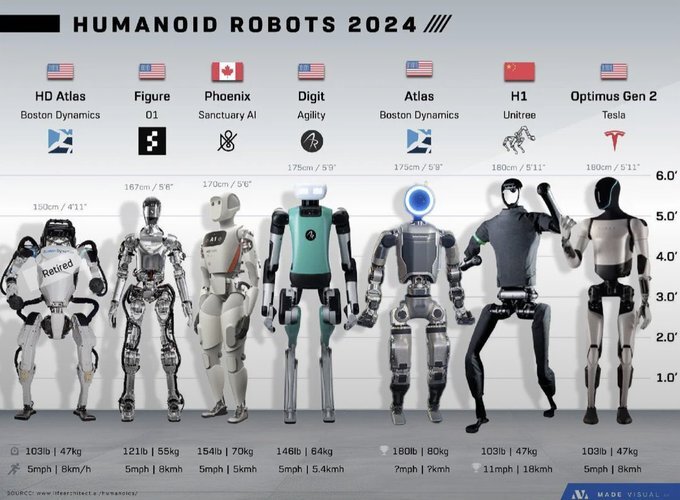
Watch Boston Dynamics' Atlas robot doing training routines, or the latest humanoids from Figure loading a washing machine, and it's easy to believe the robot revolution is here. From the outside, it seems the only remaining challenge is perfecting the AI (artificial intelligence) software to enable these machines to handle real-life environments. But the industry's biggest players know there is a deeper problem. In a recent call for research partnerships, Sony's robotics division highlighted a core issue holding back its own machines.

It noted that today's humanoid and animal-mimicking robots have a "limited number of joints", which creates a "disparity between their movements and those of the subjects they imitate, significantly diminishing their ... value". Sony is calling for new "flexible structural mechanisms" - in essence, smarter physical bodies - to create the dynamic motion that is currently missing. The core issue is that humanoid robots tend to be designed around software that controls everything centrally. This "brain-first" approach results in physically unnatural machines. An athlete moves with grace and efficiency because their body is a symphony of compliant joints, flexible spines and spring-like tendons. A humanoid robot, by contrast, is a rigid assembly of metal and motors, connected by joints with limited degrees of freedom.

To fight their body's weight and inertia, robots have to make millions of tiny, power-hungry corrections every second just to avoid toppling over. As a result, even the most advanced humanoids can only work for a few hours before their batteries are exhausted. To put this in perspective, Tesla's Optimus robot consumes around 500 watts of power per second for a simple walk. A human accomplishes a more demanding brisk walk using only around 310 watts per second. The robot is therefore burning nearly 45% more energy to accomplish a simpler task, which is a considerable inefficiency.

Diminishing returns

So, does this mean the entire industry is on the wrong path? When it comes to their core approach, yes. Unnatural bodies demand a supercomputer brain and an army of powerful actuators, which in turn make robots heavier and thirstier for energy, deepening the very problem they aim to solve. The progress in AI might be breathtaking, but it leads to diminishing returns. Tesla's Optimus, for instance, is smart enough to fold a t-shirt. Yet the demonstration actually reveals its physical weakness. A human can fold a t-shirt without really looking, using their sense of touch to feel the fabric and guide their movements.

Optimus, with its relatively rigid, sensor-poor hands, relies on its powerful vision and AI brain to meticulously plan every tiny motion. It would likely be defeated by a crumpled shirt on a messy bed, because its body lacks the physical intelligence to adapt to the unpredictable state of the real world. Boston Dynamics' new, all-electric Atlas is even more impressive, with a range of motion that seems almost alien. But what the viral acrobatics videos don't show is what it can't do. It could not walk confidently across a mossy rock, for instance, because its feet cannot feel the surface to conform to it. It could not push its way through a dense thicket of branches, because its body cannot yield and then spring back.

This is why, despite years of development, these robots mostly remain research platforms, not commercial products.

Why aren't the industry's leaders already pursuing this different philosophy? One likely reason is that today's top robotics firms are fundamentally software and AI companies, whose expertise lies in solving problems with computation. Their global supply chain is optimised to support this with high-precision motors, sensors and processors. Building physically intelligent robot bodies requires a different manufacturing ecosystem, rooted in advanced materials and biomechanics, which is not yet mature enough to operate at scale. When a robot's hardware already looks so impressive, it's tempting to believe the next software update will solve any remaining issues, rather than undertaking the costly and difficult task of redesigning the body and the supply chain required to build it.

Autonomous bodies

This challenge is the focus of mechanical intelligence (MI), which is being researched by numerous teams of academics around the world, including mine at London South Bank University. It derives from the observation that nature perfected intelligent bodies millions of years ago. These were based on a principle known as morphological computation, meaning bodies can perform complex calculations automatically. A pine cone's scales open in dry conditions to release seeds, then close when it's damp to protect them. This is a purely mechanical response to humidity with no brain or motor involved. The tendons in the leg of a running hare act like intelligent springs. They passively absorb shock when the foot hits the ground, only to release the energy to make its gait stable and efficient, without requiring so much effort from the muscles.

Think about the human hand. Its soft flesh has the passive intelligence to automatically conform to any object it holds. Our fingertips act like a smart lubricator, adjusting moisture to achieve the perfect level of friction for any given surface. If these two features were incorporated into an Optimus hand, it would be able to hold objects with a fraction of the force and energy currently required. The skin itself would become the computer.

MI is all about designing a machine's physical structure to achieve passive automatic adaptation - the ability to respond to the environment without needing active sensors or processors or extra energy. The solution to the humanoid trap is not to abandon today's ambitious forms, but to build them according to this different philosophy. When a robot's body is physically intelligent, its AI brain can focus on what it does best: high-level strategy, learning and interacting with the world in a more meaningful way.

Researchers are already proving the value of this approach. For instance, robots designed with spring-like legs that mimic the energy-storing tendons of a cheetah can run with remarkable efficiency. My own research group is developing hybrid hinges, among other things. These combine the pinpoint precision and strength of a rigid joint with the adaptive, shock-absorbing properties of a compliant one. For a humanoid robot, this could mean creating a shoulder or knee that moves more like a human's, unlocking multiple degrees of freedom to achieve complex, life-like motion.

The future of robotics lies not in a battle between hardware and software, but in their synthesis. By embracing MI, we can create a new generation of machines that can finally step confidently out of the lab and into our world.

Hamed Rajabi, Director of Mechanical Intelligence (MI) Research Group, London South Bank University

This article is republished from The Conversation under a Creative Commons license.

Read the original article.


.
 

AD1184

Celestial

Today's robots are impressive, but something is holding them back

Watch Boston Dynamics' Atlas robot doing training routines, or the latest humanoids from Figure loading a washing machine, and it's easy to believe the robot revolution is here. From the outside, it seems the only remaining challenge is perfecting the AI (artificial intelligence) software to enable these machines to handle real-life environments. But the industry's biggest players know there is a deeper problem. In a recent call for research partnerships, Sony's robotics division highlighted a core issue holding back its own machines.

It noted that today's humanoid and animal-mimicking robots have a "limited number of joints", which creates a "disparity between their movements and those of the subjects they imitate, significantly diminishing their ... value". Sony is calling for new "flexible structural mechanisms" - in essence, smarter physical bodies - to create the dynamic motion that is currently missing. The core issue is that humanoid robots tend to be designed around software that controls everything centrally. This "brain-first" approach results in physically unnatural machines. An athlete moves with grace and efficiency because their body is a symphony of compliant joints, flexible spines and spring-like tendons. A humanoid robot, by contrast, is a rigid assembly of metal and motors, connected by joints with limited degrees of freedom.

To fight their body's weight and inertia, robots have to make millions of tiny, power-hungry corrections every second just to avoid toppling over. As a result, even the most advanced humanoids can only work for a few hours before their batteries are exhausted. To put this in perspective, Tesla's Optimus robot consumes around 500 watts of power per second for a simple walk. A human accomplishes a more demanding brisk walk using only around 310 watts per second. The robot is therefore burning nearly 45% more energy to accomplish a simpler task, which is a considerable inefficiency.

Diminishing returns

So, does this mean the entire industry is on the wrong path? When it comes to their core approach, yes. Unnatural bodies demand a supercomputer brain and an army of powerful actuators, which in turn make robots heavier and thirstier for energy, deepening the very problem they aim to solve. The progress in AI might be breathtaking, but it leads to diminishing returns. Tesla's Optimus, for instance, is smart enough to fold a t-shirt. Yet the demonstration actually reveals its physical weakness. A human can fold a t-shirt without really looking, using their sense of touch to feel the fabric and guide their movements.

Optimus, with its relatively rigid, sensor-poor hands, relies on its powerful vision and AI brain to meticulously plan every tiny motion. It would likely be defeated by a crumpled shirt on a messy bed, because its body lacks the physical intelligence to adapt to the unpredictable state of the real world. Boston Dynamics' new, all-electric Atlas is even more impressive, with a range of motion that seems almost alien. But what the viral acrobatics videos don't show is what it can't do. It could not walk confidently across a mossy rock, for instance, because its feet cannot feel the surface to conform to it. It could not push its way through a dense thicket of branches, because its body cannot yield and then spring back.

This is why, despite years of development, these robots mostly remain research platforms, not commercial products.

Why aren't the industry's leaders already pursuing this different philosophy? One likely reason is that today's top robotics firms are fundamentally software and AI companies, whose expertise lies in solving problems with computation. Their global supply chain is optimised to support this with high-precision motors, sensors and processors. Building physically intelligent robot bodies requires a different manufacturing ecosystem, rooted in advanced materials and biomechanics, which is not yet mature enough to operate at scale. When a robot's hardware already looks so impressive, it's tempting to believe the next software update will solve any remaining issues, rather than undertaking the costly and difficult task of redesigning the body and the supply chain required to build it.

Autonomous bodies

This challenge is the focus of mechanical intelligence (MI), which is being researched by numerous teams of academics around the world, including mine at London South Bank University. It derives from the observation that nature perfected intelligent bodies millions of years ago. These were based on a principle known as morphological computation, meaning bodies can perform complex calculations automatically. A pine cone's scales open in dry conditions to release seeds, then close when it's damp to protect them. This is a purely mechanical response to humidity with no brain or motor involved. The tendons in the leg of a running hare act like intelligent springs. They passively absorb shock when the foot hits the ground, only to release the energy to make its gait stable and efficient, without requiring so much effort from the muscles.

Think about the human hand. Its soft flesh has the passive intelligence to automatically conform to any object it holds. Our fingertips act like a smart lubricator, adjusting moisture to achieve the perfect level of friction for any given surface. If these two features were incorporated into an Optimus hand, it would be able to hold objects with a fraction of the force and energy currently required. The skin itself would become the computer.

MI is all about designing a machine's physical structure to achieve passive automatic adaptation - the ability to respond to the environment without needing active sensors or processors or extra energy. The solution to the humanoid trap is not to abandon today's ambitious forms, but to build them according to this different philosophy. When a robot's body is physically intelligent, its AI brain can focus on what it does best: high-level strategy, learning and interacting with the world in a more meaningful way.

Researchers are already proving the value of this approach. For instance, robots designed with spring-like legs that mimic the energy-storing tendons of a cheetah can run with remarkable efficiency. My own research group is developing hybrid hinges, among other things. These combine the pinpoint precision and strength of a rigid joint with the adaptive, shock-absorbing properties of a compliant one. For a humanoid robot, this could mean creating a shoulder or knee that moves more like a human's, unlocking multiple degrees of freedom to achieve complex, life-like motion.

The future of robotics lies not in a battle between hardware and software, but in their synthesis. By embracing MI, we can create a new generation of machines that can finally step confidently out of the lab and into our world.

Hamed Rajabi, Director of Mechanical Intelligence (MI) Research Group, London South Bank University

This article is republished from The Conversation under a Creative Commons license.

Read the original article.


.
Muscle also performs a trick that, as far as I am aware, no artificial machine can duplicate: the direct conversion of chemical energy to mechanical energy. All machines created by humans that derive mechanical energy from chemical energy must do so by first converting it into some intermediate form (e.g. heat, electrical).
 
Last edited:
Top